
Keeping the Paper Dry
The centre of the Church's mission is rarely lost to bad things. It’s lost to good ones.


The Main Item of Business
I gave my life to Jesus just before midnight on Hindley Street, outside a pub, when I was nineteen. Two heavy-metal Christian evangelists stopped me on the footpath and told me about Jesus, and that night I made him Lord of my life.
But that moment did not come out of nowhere. It came after a single mum at my work had spent months quietly telling me her story. It came after an old school friend, newly a Christian himself, looked me up and started walking beside me. By the time I stood on that street corner, the good news had been getting under my skin for half a year. I came to faith, in other words, through the word of God and the prayers of ordinary people.
Not long after, I was living with my mum at Henley Beach. One evening I walked past a local church and noticed a handful of people sitting in a circle in the foyer. I’m a Christian now, I thought — I’ll say hello. I knocked, and they kindly waved me in. It was their church council meeting.
The main item of business that night was the photocopying paper. Winter was coming, and they were worried the damp would get into it and jam the machine. They gave it a good deal of time. I even offered a suggestion or two.
I look back very fondly on that church. They were gracious enough to fold a nineteen-year-old stranger into their evening. But thirty-odd years on, I find myself asking a question about that meeting — not unkindly, but honestly. Should the main item of business really have been the paper? Or should it have been something else: how are we growing our people in the word? How are we making Jesus known? How are we, as leaders, giving ourselves to prayer?
I had come to faith through the word and prayer of others. And I had wandered into a church meeting that was, that night, mostly about paper.
That question has never quite left me. And it is the question Acts 6 puts on the table.
A Growing Church and an Honest Problem
By Acts 6 the church is flourishing and fracturing at the same time.1 The numbers are climbing — and a complaint arises. The Greek-speaking believers feel their widows are being overlooked in the daily distribution of food, passed over in favour of the Aramaic-speaking ones.
Luke does not airbrush it. He could have handed us a tidy portrait of a perfect Spirit-filled community. Instead he tells the truth: even here, even now, there are widows being missed, and people who notice and say so.
And the word he chooses for their complaint is loaded. It is gongysmos — the very word used all through the Old Testament for Israel grumbling in the wilderness against Moses and against God. Luke is quietly warning us: this is not a small administrative hiccup. This is the kind of fracture that once derailed a whole generation.
What the Apostles Would Not Give Up
The apostles’ answer has been badly misread. “It would not be right for us,” they say, “to neglect the ministry of the word of God in order to wait on tables” (Acts 6:2).
Read carelessly, that sounds like clergy declining the menial work — the word for important people, the tables for everyone else. That is precisely not what is happening.
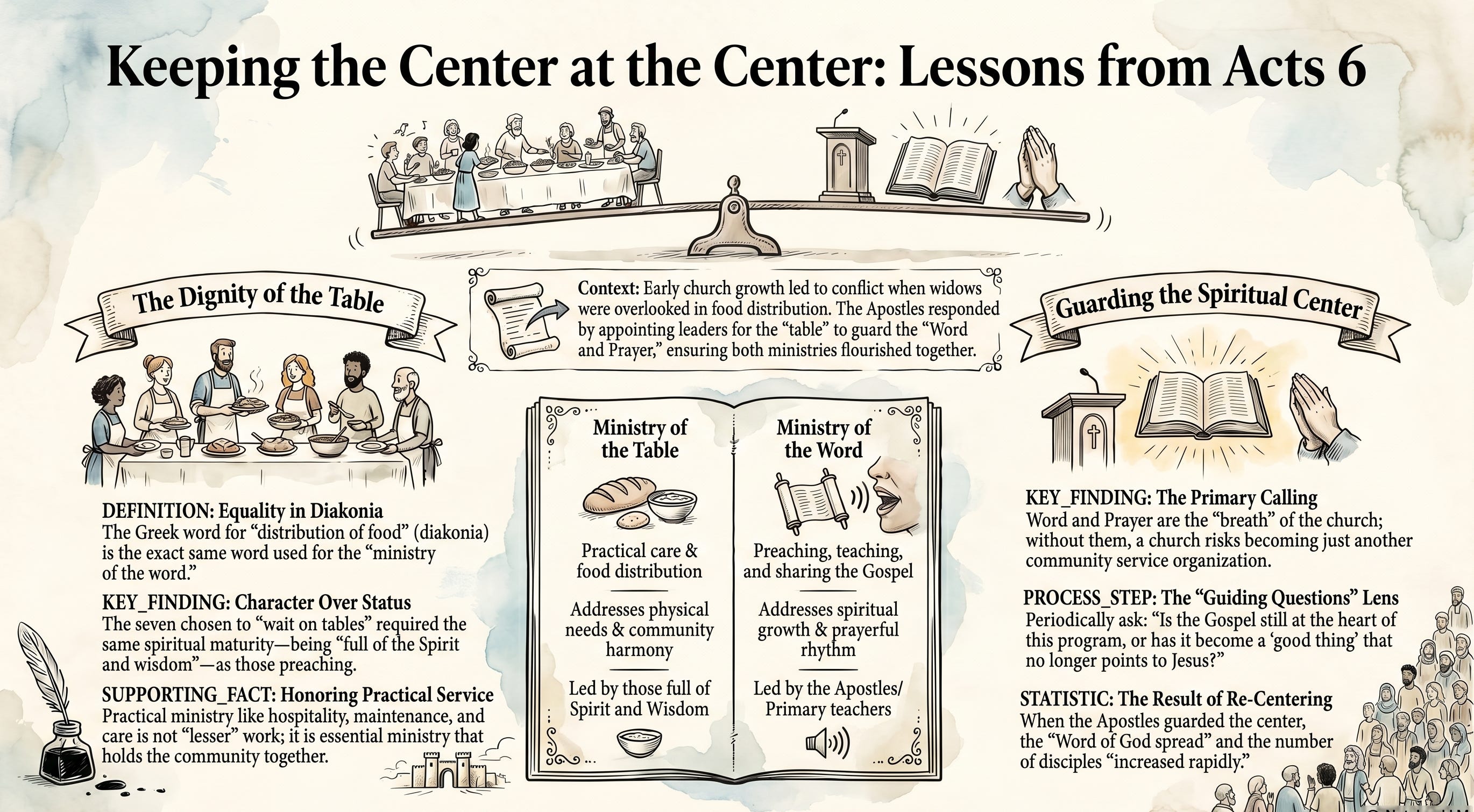
What the apostles are protecting is not their status. It is the centre. The church has a primary, non-negotiable calling: the ministry of the word of God and the prayerfulness of God’s people — the Scriptures preached and taught, the good news of Jesus proclaimed to those who don’t yet know him, and the steady rhythm of prayer that is the breath of the whole body. And that calling can be crowded out. Not usually by bad things. Almost always by good ones.
The centre is rarely lost to bad things. It is lost to good ones.
This is the quiet danger every healthy church faces. Not corruption. Not scandal. Just drift — a slow, well-meant migration of attention away from the word and prayer toward the thousand good and necessary things that fill a church’s life. Until, without anyone ever deciding it, the main thing is no longer the main thing.
Not Lesser, Only Different
And here is the part we must not miss, because it guards against an arrogance the passage never intends. When Luke describes the daily food distribution, the word he uses is diakonia — ministry. When he describes the apostles’ work of the word in the very next breath, he uses the same word. The Greek draws no line between them; F. F. Bruce notes that Luke uses the term impartially for both.
The seven chosen to serve the tables must be “full of the Spirit and wisdom” — exactly the qualifications you would want in a preacher. The people who serve the meal, make the visit, drive the car, send the card, sit with the grieving after the service are not lesser ministers. They are full ministers of a different shape.
The work of the table and the work of the word are called by the same name.
So this is not a complaint against the practical, hidden, faithful service that holds a church together. It is the opposite. It is a plea to honour that service as the ministry it truly is — while refusing to let it, or anything else, quietly displace the centre.
The Question Every Church Must Ask
What Acts 6 hands us, then, is more than a story about an old problem. It is a lens — a measuring rod any church in any century can hold against its own life. And the question it asks is simple and uncomfortable:
Are the ministry of the word, the proclamation of Jesus, and the prayerfulness of this community still at the centre of what we are and do? Or have good things — worthy things, well-meant things — slowly moved in and crowded the centre out?
A church can be busy with genuinely good work — feeding people, running events, improving the neighbourhood, maintaining the building — and still, almost without noticing, become something other than a church in the New Testament sense. A good community organisation. A charity. A group of decent people doing some good together. The test of a church’s health across two thousand years has never been its size, its budget, or even the quantity of good it does. The test is whether the word is preached, the gospel proclaimed, and the people shaped by prayer.
These are not questions to beat ourselves with. They are questions to guard ourselves with. When the apostles asked their version of it, the result was not less care for the widows. It was a fuller, more honoured, more shared ministry of the tables — and a protected ministry of the word. The whole church flourished, precisely because the centre was kept the centre.
The Word Spread
And then Luke writes one of the quietly stunning lines in Acts: “So the word of God spread. The number of disciples in Jerusalem increased rapidly, and a large number of priests became obedient to the faith” (Acts 6:7).
Notice the subject of that sentence. Not the apostles. Not even the church. The word of God spread. Tom Wright puts it plainly: the early church did not grow because its leaders were gifted managers or its strategy was clever. It grew because God was growing it — and the ministry of the word and prayer was the means he used. Even temple priests, who had every reason to resist a movement built on a crucified rabbi, were drawn in.
This is what God does when a church holds its centre.
Back to the Centre
I suspect that little church at Henley Beach was much like most of ours — including the one I now serve. We are small. We carry real ministries, many of them held by some of the most faithful and unnoticed servants you could meet. We honour all of it. None of it is the enemy. The photocopying paper still matters. So do the morning teas, the property, the budget, the calendar.
But none of them are the centre.
So let me make the question personal, because it always lands there first. Where is the word of God in your week — not in theory, but actually? When did you last sit with a passage and let it work on you? When did you last speak of Jesus to someone who doesn’t yet know him? And where is prayer in your daily rhythm — not as a duty, but as the breath of your life with God? If these have slipped — and they slip for all of us, in every season — let this be an invitation back to the centre. Not in shame. In gladness. The word is still alive. Prayer is still the easiest thing in the world to begin again.
And for us together, as churches: may the main thing always be the main thing. May the word be preached, the gospel proclaimed, and the people shaped by prayer — so that we might see, in our own day, what Luke saw in his: the word of God spreading in ways we could never engineer. That is the vision worth giving our lives to — a new generation finding Jesus and his people, in the Adelaide Hills and beyond.
That the next nineteen-year-old wandering past on a winter evening might find, at the centre of it all, not the paper — but Jesus.
Blessings,
Nicholas.
Go Deeper
This piece grew out of a recent sermon in our church’s journey through the book of Acts. If you’d like to sit with the passage a little longer:

Watch the sermon — the message this article is drawn from:
Infographic (forgive the US spelling!)
Bruce, F. F. The Book of the Acts. Rev. ed. New International Commentary on the New Testament. Grand Rapids: Eerdmans, 1988.
Longnecker, Richard N. “The Acts of the Apostles.” In The Expositor’s Bible Commentary, vol. 9. Grand Rapids: Zondervan, 1981.
Parsons, Mikeal C. Acts. Paideia Commentaries on the New Testament. Grand Rapids: Baker Academic, 2008.
Witherington, Ben, III. The Acts of the Apostles: A Socio-Rhetorical Commentary. Grand Rapids: Eerdmans, 1998.
Wright, N. T. Acts for Everyone, Part One: Chapters 1–12. London: SPCK; Louisville: Westminster John Knox, 2008.